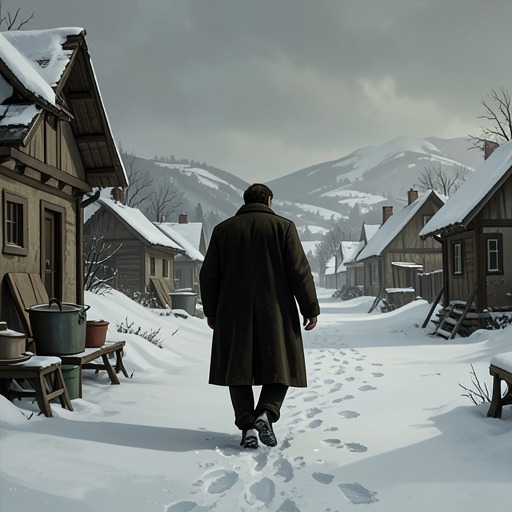
Augustine Begins Searching for Human Survivors
Good Morning, MidnightAugustine Begins Searching for Human Survivors marks a decisive change in Augustine’s relation to isolation. At Barbeau Observatory, he had accepted the silence beyond the outpost and had once regarded his own death there as an appropriate ending. After his attention shifts toward Iris’s future and the possibility of connection, he turns from the telescope to ham radio and sends a call into the bands. The action does not secure rescue or establish that anyone is listening; its significance lies in Augustine’s renewed determination to seek a human voice despite those limits.
From an Intended Ending to a New Responsibility
Augustine’s search begins against a long-standing acceptance of death, not a sudden fear of it. Before reaching the Arctic, he had imagined the research project as the final work of his career, its capstone and conclusion. He had pictured his legacy preserved in scientific archives while his own life quietly ended at Barbeau Observatory. The evacuation of the other researchers, followed by the eerie silence and presumed catastrophe, seemed to fit that expectation rather than overturn it. Being marooned did not trouble him as a practical predicament: he had already imagined dying alone in a remote place.
That settled outlook begins to change through his experience of Iris and, in particular, a sighting of the polar bear. As he watches Iris playing on the slope, her face bright with color, the bear disappears from the mountain range. Augustine recognizes discontent in himself, but also feels it on the bear’s behalf. The encounter makes his former acceptance of absence less complete: he thinks of Iris and feels gratitude for a presence. The narrative connects that unfamiliar feeling to the opening that precedes his decision to search.
The shift has consequences for how Augustine thinks about time. Early in his life with Iris, he had idly wondered what would become of her after his death. Following the bear sighting, as the sun remains above the horizon for longer, he considers her future more seriously. Rather than limiting his thoughts to his own remaining years, he begins to want connection, love, and community for her. He also recognizes that continuing to give her the emptiness he had accepted for himself would mean making excuses for his inability to offer anything more. Searching for survivors becomes an action shaped by concern for a future beyond his own.
Why He Turns to the Radio
Augustine had already made tentative efforts to contact whatever remnants of humanity might remain after the researchers evacuated. When the satellites proved silent and commercial radio stations went off the air, however, he stopped. He had become comfortable with the idea that no one remained to contact and that everything had ended. The renewed search therefore reverses an earlier retreat: silence had once seemed sufficient evidence to stop trying, but now he is determined to test it again.
He understands the difference between making contact and being rescued. The observatory’s remoteness makes a successful search logistically difficult: even if he found a surviving pocket of humanity, he had no way to get there. He knows the odds of finding anyone are poor, and does not expect to be rescued or discovered. Those limits remain in view when he acts. His aim has changed because the connection itself matters, not because he has found a plausible route out of the Arctic.
The Equipment and Its Limits
Before transmitting, Augustine checks the satellite phones and broadband network in the control room, making sure he has not overlooked a working connection. Neither offers a route to the outside world, leaving ham radio as the remaining option. Communication from the outpost had always been haphazard and mostly dependent on satellites; the radio equipment, kept for backup, is less than ideal for a search across a silent world.
Its power supply is weak, and its antenna sensitivity weaker still. It had been used chiefly to communicate with the military base at the island’s northern tip and with passing aircraft. A signal would need to be very close, very powerful, or carried by a fortunate sky-wave to register. Even then, someone would have to be listening. These technical constraints keep the search from becoming a confident rescue plan: Augustine is working with equipment designed for limited backup communication, not reliable contact across an unknown distance.
The Call of KB1ZFI
The radio draws on a skill Augustine acquired long before the Arctic crisis. At eleven or twelve, he built crystal sets from wire, screws, and semiconductor diodes, then moved on to transmitters, receivers, and decoders. He made radios from kits, from scratch, and from scavenged appliances, and assembled antennas from whatever parts he could find. His father, a mechanic who worked on the enormous machinery of car factories, took an interest in the boy’s small-scale experiments. Radio had once opened an unexpected point of intimacy between them.
As a child, Augustine would transmit a CQ from the basement and scan the empty ham frequencies until someone answered. He collected QSL postcards confirming contacts, but the cards were secondary to the fact of a voice at the other end. He wanted to know that someone was there, even if he could not picture or meet that person. In the Arctic, this old practice acquires a different weight: a childhood means of reaching strangers becomes his deliberate response to planetary silence.
Augustine checks and fine-tunes what equipment he can, then turns it on. Iris watches his work with vague curiosity and later wanders among the outbuildings, visible from the window as a small dark shape against the snow. He takes up the handheld microphone, presses the transmit button, releases it, clears his throat, and presses it again. He identifies himself as KB1ZFI, spelling out the call sign, and asks whether anyone is there. The scene ends with the call itself, not a confirmed reply. Its importance is that Augustine has begun asking again: against his earlier acceptance of an ending, he sends a signal whose answer he cannot control.